Keystone Species: Meaning, Role, and Examples
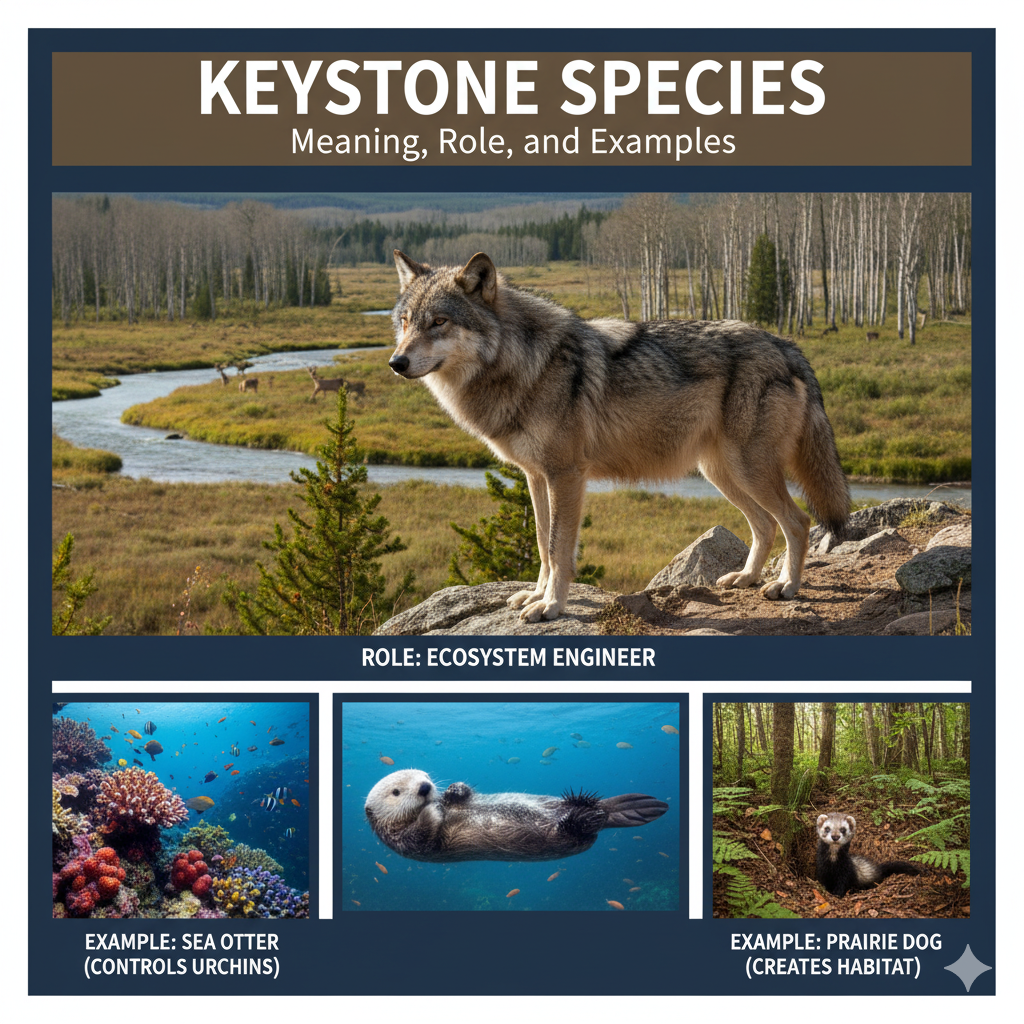
keystone species
Every ecosystem on Earth functions like a finely tuned orchestra, where each organism contributes to the balance of life. Yet, some species play roles so critical that their removal can cause the entire system to collapse. These organisms are known as keystone species, and understanding them is essential for anyone interested in ecology, conservation, or the future of biodiversity.
What is a Keystone Species?
When students, researchers, or enthusiasts ask what is a keystone species, the simplest way to explain it is this: a keystone species is an organism that has a disproportionately large impact on its environment relative to its abundance. That means even if the species is not the most numerous or the largest, its presence influences the survival, population, and interaction of many other organisms in the same ecosystem. Without these species, ecosystems often experience dramatic changes, sometimes even leading to collapse.
Keystone Species Definition
The formal keystone species definition can be described as: a species whose presence and role within an ecosystem has a significant effect on the structure and functioning of that system, and whose removal would lead to major shifts in ecosystem composition and functioning. This term was introduced by ecologist Robert T. Paine in 1969, based on his experiments with intertidal species. The idea quickly gained recognition because it explained why some ecosystems remain stable while others deteriorate rapidly.
Why Keystone Species Matter
The importance of keystone species lies in their ecological roles. They regulate populations, maintain diversity, influence nutrient cycles, and support habitats. Without them, ecosystems often lose balance, resulting in cascading effects where multiple species are affected. The presence of keystone species is often the difference between a thriving, balanced ecosystem and one that is unstable and vulnerable to collapse.
Types of Keystone Species
Not all keystone species perform the same ecological function. Ecologists classify them into several categories depending on how they affect their ecosystems:
- Predator keystone species: Control populations of prey and prevent overgrazing or dominance by one species.
- Prey keystone species: Provide a crucial food source for predators during times of scarcity.
- Ecosystem engineer keystone species: Physically modify the environment, creating habitats for other organisms.
- Mutualist keystone species: Maintain relationships with other species that are essential for survival, such as pollinators.
- Plant keystone species: Provide shelter, food, or structure critical to other organisms.
This classification shows that keystone species are not limited to predators but can include plants, herbivores, or even tiny organisms like insects.
Keystone Species Examples
When explaining keystone species examples, it is useful to consider a wide variety of ecosystems. Here are some well-documented cases:
- Sea otters (Predator keystone species): In kelp forest ecosystems, sea otters feed on sea urchins. Without otters, sea urchins overpopulate and consume kelp, destroying habitats for fish, invertebrates, and marine mammals.
- Wolves in Yellowstone National Park (Predator keystone species): Wolves regulate elk populations. Their absence once led to overgrazing, but their reintroduction restored vegetation, stabilized riverbanks, and improved habitats for birds and beavers.
- Beavers (Ecosystem engineers): By building dams, beavers create wetlands that support fish, amphibians, birds, and plants. Their role demonstrates how a single species can reshape landscapes.
- Fig trees (Plant keystone species): In tropical forests, fig trees bear fruit year-round, feeding numerous animals. Without figs, many species would face seasonal food shortages.
- Honeybees (Mutualist keystone species): Pollination by bees supports countless plants, which in turn sustain herbivores and predators. Their decline threatens entire food chains.
These keystone species examples highlight the broad influence of organisms across different ecosystems and illustrate why conservation efforts often prioritize them.
How Keystone Species Influence Biodiversity
The presence of keystone species maintains balance by preventing one species from dominating. For instance, without wolves, elk populations grew unchecked, leading to the loss of plant species. Similarly, without sea otters, kelp forests collapsed. By regulating populations, keystone species ensure that multiple organisms coexist, thereby maintaining biodiversity. This regulation also prevents invasive species from overwhelming ecosystems.
The Concept of Trophic Cascades
Understanding keystone species also requires looking at trophic cascades. A trophic cascade occurs when a change in the population of one species causes ripple effects through multiple levels of the food chain. Keystone predators are especially known for initiating trophic cascades. For example, wolves in Yellowstone controlled elk, which allowed willow and aspen trees to grow, which in turn supported birds and stabilized streams. This shows how one species indirectly influences water systems, plants, and other animals.
Human Impact on Keystone Species
Human activities like deforestation, hunting, pollution, and climate change have placed many keystone species at risk. Removing or reducing these species leads to severe ecological consequences. For example:
- Overfishing reduces shark populations, causing imbalances in marine ecosystems.
- Habitat loss threatens elephants, which shape savannas by knocking down trees and maintaining grasslands.
- Pesticide use reduces pollinators like bees, undermining global food production.
Protecting keystone species therefore has broader implications for climate regulation, agriculture, and global stability.
How Scientists Identify Keystone Species
Identifying keystone species is complex. Scientists look at factors such as:
- Impact on ecosystem balance compared to population size
- Role in food webs and nutrient cycles
- Evidence of trophic cascades when the species is removed
- Contribution to habitat creation or modification
These studies involve field experiments, long-term monitoring, and ecological modeling. Robert T. Paine’s experiments with starfish are a classic example, where removing starfish caused mussels to dominate and reduced species diversity drastically.
Conservation Strategies for Keystone Species
Protecting keystone species involves multiple approaches:
- Establishing protected areas to safeguard habitats
- Reintroducing keystone predators to restore balance
- Regulating hunting, fishing, and exploitation
- Supporting pollinator populations by reducing pesticide use
- Raising awareness about the importance of biodiversity
Conservation efforts often focus on keystone species because protecting them indirectly safeguards many other organisms in the ecosystem.
Keystone Species vs. Dominant Species
It is important not to confuse keystone species with dominant species. Dominant species are those that are numerically abundant or have a large biomass, such as grass in a savanna or trees in a forest. Keystone species, on the other hand, may be relatively rare but exert enormous influence. For instance, wolves are fewer in number compared to elk, yet their presence has more impact on ecosystem stability.
Challenges in Keystone Species Research
While the concept of keystone species is widely accepted, ecologists face challenges in identifying and managing them. Ecosystems are complex, and removing one species may have unpredictable results. Furthermore, climate change alters the roles of species, making it difficult to identify keystone roles that shift over time.
Future of Keystone Species Conservation
The future of keystone species depends on integrated conservation strategies that combine local action with global cooperation. Technology like satellite monitoring, AI-based ecological modeling, and genetic studies can provide deeper insights. Communities living near ecosystems must also be included in conservation strategies since they often rely on these species for resources and cultural significance.
Final Thoughts
The study of keystone species provides an essential lens for understanding ecology. By answering what is a keystone species, learning the keystone species definition, and exploring keystone species examples, we gain insight into the invisible forces that sustain ecosystems. Protecting these species is not just about saving individual animals or plants; it is about safeguarding entire networks of life. Whether it is wolves shaping forests, bees ensuring food security, or beavers constructing wetlands, keystone species remind us that balance in nature often depends on a few critical players. Preserving them ensures that biodiversity thrives, ecosystems remain resilient, and future generations inherit a stable natural world.